AI-Enabled MedTech Without the Traditional Workflow
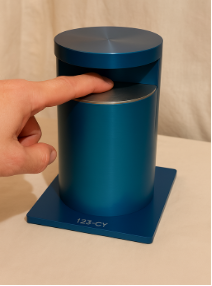
- Diagnose without a specimen.
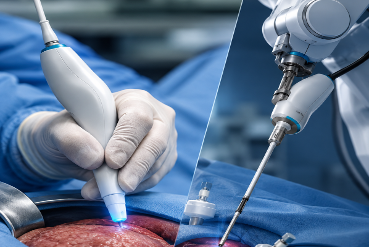
- Detect and treat cancer at the surgical margin.
- Automatically correct IV infusion interruptions.
Three patented technology platforms designed to eliminate delays, unnecessary steps, and preventable clinical workflow failures.
One instinct, three applications
Every 123IV platform is built on the same idea: solve the clinical problem before it becomes a delay, an alarm, or a diagnosis that arrives too late.
No-Specimen Diagnostics
Real-time disease detection without blood, swabs, or laboratory processing.
Explore the platformPrecision Surgical Oncology
Detect. Treat. Confirm. — one probe, at the surgical margin.
Explore the platformAutonomous Infusion
Correct the problem before the alarm becomes the problem.
Explore the platformDiagnosis, at the speed of light
A laser, a sensor, and a trained model replace the swab, the vial, and the wait.
Detect. Treat. Confirm.
The next generation of the optical platform, built for the operating room instead of the bedside.
Built on the same optical and machine-learning foundation as the point-of-care diagnostic platform, extended for the precision a surgical margin demands. Raman spectroscopy identifies suspect tissue; elastography adds mechanical context; focal treatment and a confirmatory re-scan close the loop before the surgeon closes the incision.
Correct the problem before the alarm becomes the problem
Most IV pump alarms aren't emergencies — they're kinked tubing and upstream occlusions that can be corrected before anyone needs to respond.
Alarm fatigue has been recognized as one of the most significant health-technology safety hazards for over a decade, and clinical alarm safety has been a mandated National Patient Safety Goal since 2014.
Built with Team A9 at the Stevens Institute of Technology, this retrofit module mechanically detects and corrects tubing failures before they escalate to an alarm — designed to work around the pump infrastructure hospitals already own.
Surgeons and engineers
A small team spanning clinical medicine, optical engineering, and machine learning — built around one surgeon's decade of patented device work.
Allen B. Chefitz, MD
Led the design, build, and clinical validation of the no-specimen diagnostic device. Holds multiple patents across the diagnostic and therapeutic space.
Elisa Long, MD
MS in Computer Science, MIT. Leads partnership development and study execution, including collaborations with Northeastern University and MIT CSAIL.
Rohit Singh, PhD
Research scientist at MIT specializing in machine learning and genomics. Co-inventor of the no-specimen diagnostic device and co-founder of Martini.ai.
Yongwu Yang, PhD
PhD in Physical Chemistry, MIT. Brought Raman spectroscopy expertise to the finger-inserted diagnostic device.
Gregg Vesonder, PhD
Former Bell Labs engineer, now on the faculty at Stevens Institute of Technology. Advises on system architecture and scalable deployment.
Peter Szolovits, PhD
Professor at MIT EECS and head of the Clinical Decision-Making Group at MIT CSAIL, with an appointment in the Harvard/MIT HST program.
A portfolio of protected inventions
Eight issued U.S. patents so far, organized by platform, plus continuations, foreign filings, and pending applications.
Along with several continuation patents, foreign applications, and pending filings.
Have a pilot site, a partnership, or a press question?
We work with health systems, research institutions, and investors who want diagnostics and infusion safety that move as fast as the patients who need them.